Mariko Uda Raises Awareness of Torontonians with their Rivers in her Self-published Book
![]()
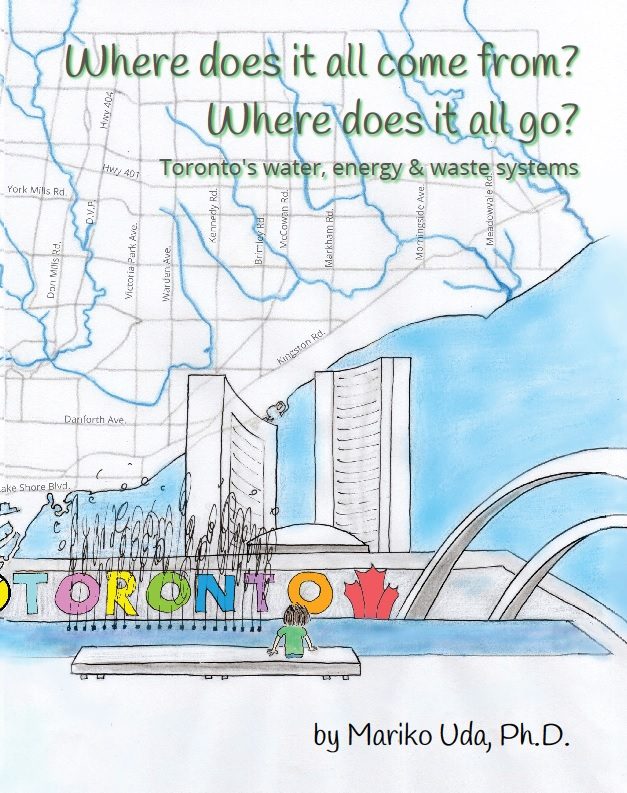
Mariko Uda’s journey into self-publishing started because of a book festival. Booking a table in 2019 at The Word On The Street Toronto set the deadline to finally publish her book, which she developed the idea of writing after years of studying various environmental disciplines.
Uda considers herself an environmentalist. She studied biology and chemistry at university. After a few years working for Ontario Power Generation, she studied for her second undergraduate degree in civil engineering. She also did a certificate in architectural technology and finally finished her Ph.D in civil engineering.
Her debut book, Where Does It All Come From? Where does it all go? - Toronto’s Water, Energy, and Waste Systems is a Toronto-specific picture book. The origin of it comes from her presentation slides at different talks at the university during her Ph.D. “After doing it several times, I started to think these would make a good book,” she says.
“The book is a mix of my civil engineering, my environmental awareness, my art, and a bit of spirituality-like connection,” says Uda. Despite not attending any art academy, she has loved drawing since childhood. To create the illustrations within her book, she also took a cartooning class to learn how to draw.
Uda explains how Toronto’s water, energy and waste systems work simply. She learned how the water, sewage, and stormwater systems work when she studied civil engineering. “If people are more aware of how things work, then they're more engaged in political decisions,” she says. “I feel like everyone should know the basics.” She believes that once we have an awareness of our environment, we will develop a caring relationship.
Uda has been inspired by the land of Toronto. Learning from Indigenous people about connecting to our rivers, she realized the importance of the connection between the place and the people. By demonstrating sewage treatment plants and rivers with the maps in her book, she hopes people can create a relationship with their rivers. “The main purpose of the book is to connect people to the specific places that support their daily living,” she says.
Her friend, Helen Mills, is also an influence on her. Helen Mills is the founder of a project called Lost Rivers, and they do walks along the buried rivers. “There are places were used to be rivers in Toronto, but now the rivers are in pipes,” says Uda. “Meeting her encouraged me to get to know the land as well.” The thrust of walking upon the lost rivers is to let people connect with the land, and this thought is also built in Uda’s heart.
“To be aware of the water in me came from somewhere, the water in the lake, and so I'm connected to the lake,” says Uda. “It’s similar to being aware of the food we eat during mindfulness meditation,” she says, “The energy that we use always comes from somewhere.”
Mariko Uda’s Website
Oct, 2022
Uda considers herself an environmentalist. She studied biology and chemistry at university. After a few years working for Ontario Power Generation, she studied for her second undergraduate degree in civil engineering. She also did a certificate in architectural technology and finally finished her Ph.D in civil engineering.
Her debut book, Where Does It All Come From? Where does it all go? - Toronto’s Water, Energy, and Waste Systems is a Toronto-specific picture book. The origin of it comes from her presentation slides at different talks at the university during her Ph.D. “After doing it several times, I started to think these would make a good book,” she says.
“The book is a mix of my civil engineering, my environmental awareness, my art, and a bit of spirituality-like connection,” says Uda. Despite not attending any art academy, she has loved drawing since childhood. To create the illustrations within her book, she also took a cartooning class to learn how to draw.
Uda explains how Toronto’s water, energy and waste systems work simply. She learned how the water, sewage, and stormwater systems work when she studied civil engineering. “If people are more aware of how things work, then they're more engaged in political decisions,” she says. “I feel like everyone should know the basics.” She believes that once we have an awareness of our environment, we will develop a caring relationship.
Uda has been inspired by the land of Toronto. Learning from Indigenous people about connecting to our rivers, she realized the importance of the connection between the place and the people. By demonstrating sewage treatment plants and rivers with the maps in her book, she hopes people can create a relationship with their rivers. “The main purpose of the book is to connect people to the specific places that support their daily living,” she says.
Her friend, Helen Mills, is also an influence on her. Helen Mills is the founder of a project called Lost Rivers, and they do walks along the buried rivers. “There are places were used to be rivers in Toronto, but now the rivers are in pipes,” says Uda. “Meeting her encouraged me to get to know the land as well.” The thrust of walking upon the lost rivers is to let people connect with the land, and this thought is also built in Uda’s heart.
“To be aware of the water in me came from somewhere, the water in the lake, and so I'm connected to the lake,” says Uda. “It’s similar to being aware of the food we eat during mindfulness meditation,” she says, “The energy that we use always comes from somewhere.”
Mariko Uda’s Website
Oct, 2022